Virgilio Martínez Y Pia Leon 2024
Sani Magazine 2026

Two internationally acclaimed chefs, partners in life, who have built a family together while sharing experiences of gastronomy and coexistence. He visited Sani Gourmet last summer, and this year it is her turn to present her creations to the destination’s guests.

Virgilio Martínez is widely regarded as the leading figure of modern Peruvian haute cuisine. As the chef-owner of “Central” in Lima, he has earned global acclaim, most notably when it was named No. 1 in the world by The World’s 50 Best Restaurants in 2023. Martínez is the founder of Mater, a research centre dedicated to exploring Peru’s biodiversity and native ingredients, which deeply informs his culinary philosophy.

Pía León is one of the most prominent chefs of her generation and a central force behind Peru’s contemporary culinary movement. She was named World’s Best Female Chef in 2021 by The World’s 50 Best Restaurants, recognising her creative leadership and global impact. León is the chef-owner of Kjolle, where she explores her vision of Peru’s megadiverse territory. Kjolle is No. 2 in Latin America and No. 9 in the world according to The World’s 50 Best Restaurants ranking.

SG25 Virgilio Martínez (8 Of 150) 2500X1667

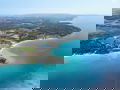
Taking part in Sani Gourmet was motivating in many ways. Working in a place surrounded by landscape and the sea.

Virgilio

You are not only two of the most influential chefs in the world, but also partners in life. How does sharing both your personal and professional worlds shape your creativity and daily life?

To be honest, we don’t really separate the personal from the professional aspects. When it comes to our relationship with gastronomy, with people, with our teams, with family, with the community — it all becomes one. At the end of the day, we live together: we sleep together, we move through life together, we wake up and spend our days surrounded by people connected to food, creativity, and innovation. We travel together in search of inspiration; we may split to work in different restaurants, but we’re still in the same building. So, we are continually finding balance. I wouldn’t say it’s perfect, because it also requires discipline and consistency. But by always aiming for higher motivations, we’re able to sustain a way of working where we constantly strive for excellence.

Virgilio, you participated in last year’s Sani Gourmet. What was your experience like cooking in Greece, and what moments stayed with you the most?

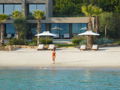
Taking part in Sani was motivating in many ways. Being in Greece itself was inspiring, being in such a beautiful setting, on a stunning coastline, working in a place surrounded by landscape and the sea. It was also very meaningful to see their relationship with food and the products of Greece, which are deeply inspiring. It’s a country with a rich gastronomic history, and going to a place with so much to share, with land that has so many stories to tell, is incredibly motivating. On the other hand, experiencing Sani as a resort, the level of hospitality and those spaces of luxury, is something you truly enjoy. It’s a place where beauty is present everywhere. And in terms of the working experience, I found a highly professional team. I had already met some of them at international gastronomic congresses; they had taken the time to get to know me beforehand, to invite me, to connect and have conversations. That gave me the confidence that I would be working with people of great quality — professionally strong, but also very human in the way they care for their teams. That’s exactly what I encountered: teams who are proud of where they work and of what they do. They welcomed me warmly, and they said goodbye in an even more meaningful way.

Pía, how do you feel about taking over this summer? Are you excited, nervous, inspired? What are you most looking forward to?

Virgilio has given me an idea of what it’s like. The kitchen is quite spacious, and the team follows the recipes and preparations very closely. I’ve also been told that the front-of-house team is very well equipped, so I’m really excited — not only to cook there, but also to experience the public. From what Virgilio has shared, the guests are very enthusiastic. And I think those are the moments when, as a cook, you truly feel that what you’re creating is being appreciated. So, of course, I feel very optimistic, but at the same time I also feel a lot of anticipation, and even a bit nervous, because I want to give my very best and fully express my cuisine using Greek products as much as possible.

LOBSTER Charapita Chili • Cecina • Crab By Camila Novoa

Working with Greek products means applying my style, my way of working, my aesthetic, and our artisanal approach to handling ingredients.

Pía

Sani Gourmet has become a true culinary institution. How important are international collaborations and festivals like this in today’s gastronomic world?

Pía: Lately, I’ve been attending many gastronomic festivals and gatherings, some of which are truly inspiring. There’s a wide range, and you have to know how to choose. I think what makes them important is that they genuinely allow us to encounter other cultures and build bridges between different gastronomies. From our side, when we travel, we bring something from Peru, we carry a lot of South America with us, and a lot of what we do in our own spaces. And within that duality, the idea of local and global, we always find something that connects us. That’s important when it comes to continuing to innovate while staying rooted in our traditions.

Your cuisine is deeply rooted in Peru’s biodiversity and cultural heritage. How do your origins continue to influence the way you create today?

Virgilio: The more I root myself, the more I focus on who we are, and who we have been as a community. By looking to the past, not only at traditions, but at ancestry and that deep connection, I find more answers and more content to express myself as a cook. Through this, you discover more products, recipes, ideas, approaches, and different paths. Diversity is incredibly inspiring, and I believe it gives you the sense that today there are infinite possibilities for expressing cuisine.

Your work often explores altitude, ecosystems, and native ingredients from Peru. When creating a menu for an international audience, such as at Sani Gourmet, how do you translate the depth and complexity of Peruvian terroir while staying authentic to your philosophy?

Pía: My philosophy when creating a menu is to work with the products and the richness that our territory offers. We often speak about altitudes, ecosystems, and seasonality. And of course, when we travel, we look for those same elements. Being by the sea for example, we will focus on marine ecosystems. There is so much that can be done when working with seafood and fish. When we speak about nature, it’s about what we find in the territory, what is grown around us. I’m not necessarily thinking of creating a menu based on altitudes, but I do want to maintain the style, the richness, and diversity of South America and of Peru — where I work and where I generate ideas. For me, it’s about bringing those ideas together and putting them into practice with local products, a challenge and a discovery at the same time. Working with Greek products means applying my style, my way of working, my aesthetic, and our artisanal approach to handling ingredients. It’s also about the way I serve, bringing the hospitality of “Kjolle” into the dining room, so that it can be felt in the details of the service — as if you were somehow sitting in “Kjolle.” 

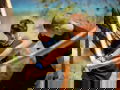
Virgilio In The Kitchen Action Photo By Antonio Escalante
Do you each have a favourite ingredient that you return to again and again?
What makes it so special for you?

Pía: Citrus — the variety of lemons, limes, citrons, fruits, oranges, and tangerines. There are so many ways to express them: with acidity, with sweetness, and with bitter nuances. The extraction of juices, the essential oils from a lime or a lemon — everything about them makes citrus a very versatile product. And also ajíes: the variety of ajíes, their colors, shapes, flavors, and even their smokiness. The versatility and richness of both spicy and non-spicy peppers.

Virgilio: I’m particularly interested in how salts can be used to build flavour — especially as a way of finishing a dish at the table. A salt can bring very specific nuances, but also a sense of place. It can connect you to a herb, a root, an ecosystem — to somewhere very precise. I’m drawn to the diversity of salts: their different colours, textures, and the way they interact with a preparation. Texture is especially important: how it feels, how it dissolves, how it carries flavour. Alongside that, I think a lot about oils, whether essential oils or animal fats, and the role they play. Not only in terms of flavour, but also texture and depth. 

Is there one dish — either from your childhood or your professional journey — that feels especially personal?

Virgilio: For me, it’s carapulcra, which is a stew made with dried potatoes, cacao, and pork. It’s a dish I’ve eaten since I was very young.
Pía: For me, it’s a slow-cooked stew called locro, made with squash, corn, cheese, and many native Peruvian herbs.

When two chefs live under the same roof, does the kitchen ever become a “no-work zone”? Who cooks at home, and do you ever disagree creatively?

Virgilio: When we’re trying to relax, there’s always a small possibility that we end up cooking, and not agreeing on the menu or the seasoning. So we start cooking like professionals, just like on weekdays, but on a Sunday. That’s why, when we cook on Sundays — which is normally our day off — and we cook for our son, or for the two of us, or sometimes for friends, we try to keep it easy. We plan it: let’s say I prepare vegetables and fish, and Pía does rice, potatoes, and meats. And then we combine everything. Or maybe I’ll look after the cheese tray and dessert, and Pía does the savouries. We try not to cross hands on the same preparations. We each do different things — we’re in the same kitchen, but I don’t touch Pía’s dishes, and she doesn’t touch mine. And that’s quite comfortable, because in a way we’re cooking on our own. During the week, in the restaurant, we have to cook together, of course, and that becomes part of the job. So the idea on Sundays is to avoid turning it into a continuation of a weekday.

You both lead ambitious projects while maintaining a family life. How do you balance intensity, travel, and creativity with intimacy and stability?

We always try to make sure that the amount of work, the pursuit of excellence, and what the projects demand — the profession, the audience, the teams, and what we demand of ourselves — do not take over what we understand to be our main project, which is the most important one we have: our family. We have a child, and we have a home to sustain, where we seek stability. It’s not easy. That’s why, from the beginning, we talked about discipline, about knowing that things need to be done well, and being very consistent with what we are looking for and what we want to do. We have big projects and ambitions, but we also know that our most important project is us. That means us as a couple, our child, and then everything else comes after. We place ourselves first. 

When it comes to our relationship with gastronomy, with people, with our teams, with family, with the community — it all becomes one.

How did you first meet, and how many years have you now shared together as a couple? Looking back, did you imagine the journey would unfold this way?

We met at the restaurant, from the very beginning of “Central” we met working together. We didn’t become a couple until around the third year of “Central.” We feel that everything has happened very fast, because while we’re together, we work a lot. Only in recent years have we found a bit more calm, also because we now have a child who requires a lot of our time, which has allowed us to settle and feel that we have a much more family-oriented life. We’ve also found a different kind of maturity as a couple, much more interesting and probably more enjoyable than the beginning. Sometimes you think it might be the opposite, but we feel that today we are in a very exciting moment as a couple, after more than ten years together.

If you could describe each other in three words — as chefs and as partners — what would those words be?

Virgilio: Pía is intuitive, very intelligent, and tenacious.
Pía: Virgilio is disciplined, almost perfectionist, and, at times, contrary to that, a bit disorganized.

Outside the kitchen and beyond the intensity of your restaurants, what does an ideal day off look like for the two of you? Is it still centered around food, or do you consciously seek distance from gastronomy?

On our days off, we don’t necessarily stay connected to gastronomy. If we are in Lima, of course we might go out to eat, spend time as a family with Cristóbal, our son, and go to an interesting restaurant — mostly seafood, or something new that has opened. We enjoy having long lunches and then look for calm and rest. Our only day off is Sunday, so when we are in Lima, we try to make the most of it by being together and doing very normal things at home. Going out to a casual restaurant — very casual — is important for us to relax and also enjoy good food. In Lima there is a lot of that: very family-oriented, casual places where you can still find very good food. It’s also a space where our son can have fun. 

https://sani-prd-cdn.azureedge.net/media/vyugiip3/pia-leon-portrait-sept-2024-by-camila-novoa.jpg?v=1dd055c837eac70&format=jpg&quality=80